
Cameras That See in the Dark: Turning Night into Day with Modern Low-Light CCTV
Modern security cameras can now see in full colour at night. Learn how Hikvision ColorVu 3.0, Dahua WizColor and AXIS Lightfinder 2.0 turn night into day.
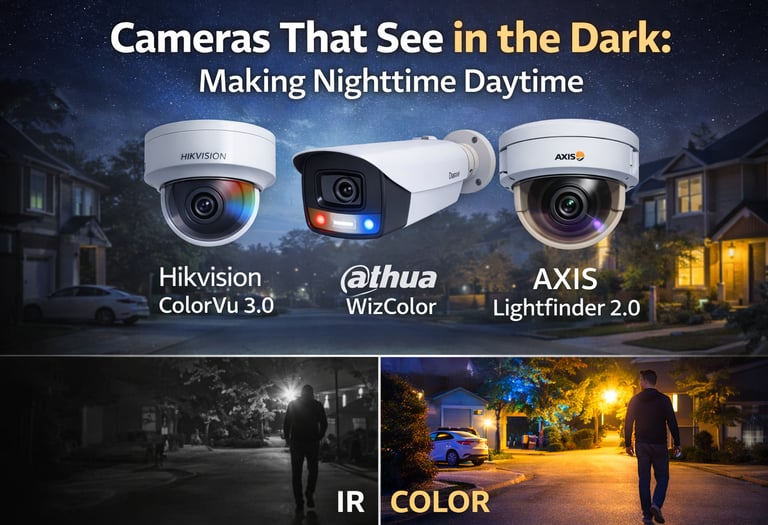
For years, night-time security footage meant grainy black-and-white images with limited detail. Today, that has changed dramatically. Thanks to advanced low-light sensor technology, AI image processing, and ultra-wide apertures, modern cameras can deliver full-colour video at night, often with little to no visible lighting.
This article explains how night-vision has evolved, why “colour at night” matters, and how leading technologies from Hikvision, Dahua, and AXIS are redefining after-dark surveillance.
Why traditional night vision falls short
Conventional CCTV relies on infrared (IR) LEDs once light levels drop. While IR is effective for detection, it has limitations:
Black-and-white images only
Loss of key identifying details (clothing colour, vehicle colour)
Overexposed faces at close range
Limited usefulness for investigations and evidence
Modern low-light cameras aim to capture more visible light instead of switching to IR, producing clearer, more natural images.
How modern cameras make night look like day
Today’s “see in the dark” cameras combine several key technologies:
Large image sensors (capture more light per pixel)
Ultra-wide aperture lenses (let in more light)
Advanced noise reduction (AI-driven, not aggressive blurring)
Smart colour processing (maintains colour accuracy in darkness)
Optional soft white light (only when needed)
The result: usable, colour-accurate video in extremely low lux environments.
Hikvision – ColorVu 3.0
Hikvision’s ColorVu 3.0 technology is designed specifically for 24/7 colour imaging, even in near-dark conditions.
What makes ColorVu different
Super-large sensors with enhanced light sensitivity
Fixed or hybrid white-light illumination (not harsh spotlights)
AI image optimisation to reduce noise while keeping detail
Best suited for
Residential streets and driveways
Strata car parks and building perimeters
Retail storefronts and entrances
ColorVu is especially effective where ambient light exists (streetlights, nearby buildings), delivering colour images where older cameras would already be in black-and-white.
Dahua – WizColor
Dahua’s WizColor technology focuses on accurate colour reproduction in ultra-low-light scenes, even without additional lighting.
Key strengths
High-performance CMOS sensors
Advanced colour-retention algorithms
Reduced reliance on IR or white light
Best suited for
Large open areas (warehouses, yards)
Sites where visible lights are undesirable
Commercial and industrial locations
WizColor cameras excel in environments where you want discreet surveillance but still need clear colour detail at night.
Axis Communications – Lightfinder 2.0
AXIS has long been regarded as a leader in image quality, and Lightfinder 2.0 represents their most advanced low-light technology to date.
What sets Lightfinder 2.0 apart
Industry-leading image processing
Natural colours with minimal motion blur
Exceptional performance in mixed lighting (headlights, shadows, glare)
Best suited for
High-end commercial sites
Transport, infrastructure, and critical facilities
Environments where image accuracy is critical
Lightfinder 2.0 prioritises true-to-life colour and contrast, making it ideal for evidentiary-grade footage.
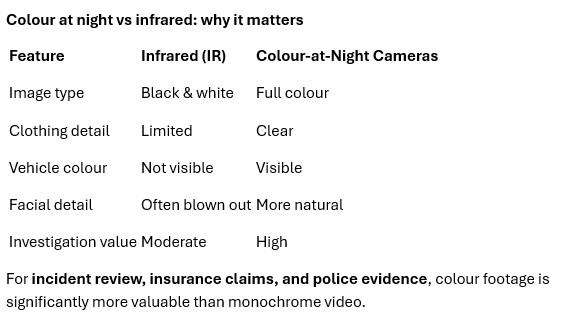
Colour at night vs infrared: why it matters
For incident review, insurance claims, and police evidence, colour footage is significantly more valuable than monochrome video.
Choosing the right night camera for your site
There is no single “best” night camera — it depends on the environment:
Low ambient light + residential/strata → Hikvision ColorVu
Large dark areas + minimal visible light → Dahua WizColor
Critical detail + premium image quality → AXIS Lightfinder 2.0
The most important factor is proper design: lens choice, mounting height, field of view, and lighting conditions all matter more than marketing terms alone.

Advance Digital Systems 2025




Master Security License: 000110785