
Why Active Deterrent Security Cameras Are a Must (Not Just “Nice to Have”)
Perfect for strata and commercial sites: discover how active deterrent cameras reduce trespass, vandalism and after-hours loitering with smart alerts.
Traditional CCTV is great at recording what happened. But when you’re trying to stop incidents — break-ins, trespass, vandalism, after-hours loitering — recording alone is often too late.
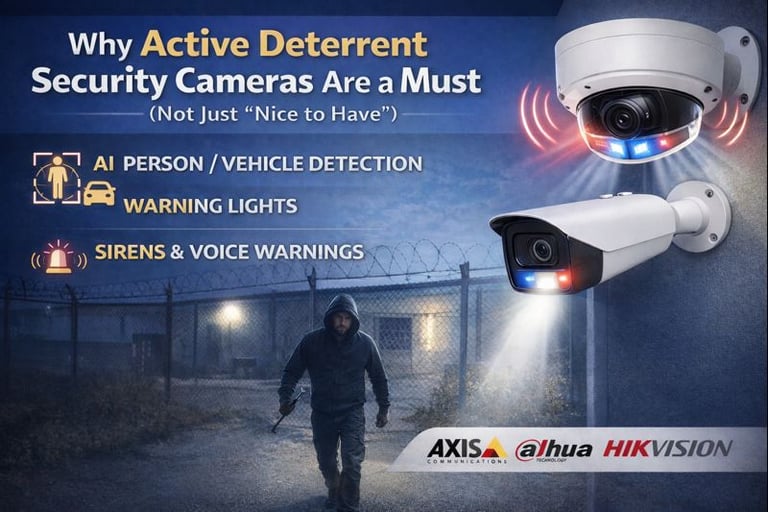
That’s where active deterrent security cameras come in. They combine smart detection (human/vehicle classification) with immediate, attention-grabbing responses such as strobe lights, sirens, and voice warnings. The goal is simple: interrupt the behaviour before the crime happens.
Below is what the research says about deterrence, why “active” responses matter, and how the major brands (AXIS, Dahua, Hikvision) approach it.
1) The research: CCTV can reduce crime — but results depend heavily on how it’s used
A major, widely cited systematic review and meta-analysis (covering 80 evaluations) found CCTV is associated with a statistically significant, but generally modest reduction in crime, with the strongest and most consistent results in certain environments.
Key findings from that meta-analysis:
Car parks: crime reduced by ~37% in treatment areas vs control areas (pooled result).
Residential areas: also showed a statistically significant reduction (smaller than car parks, but still significant in the pooled results).
Crime types: significant reductions were seen for vehicle crime and property crime, while effects were not significant for violent crime in the pooled results.
Crucially, the same review notes that in many of the strongest-performing “car park” schemes, CCTV wasn’t acting alone — they often included other measures (like improved lighting, signage, security guards) and many were actively monitored.
That’s the bridge to active deterrence: the more “certain” the detection and response feels, the more deterrent power you typically get — not just a silent recording device.
2) Passive cameras vs active deterrence: why “doing something” changes outcomes
Some public discussions point out that the evidence for cameras deterring crime (especially in individual homes) can be mixed, and that context matters.
So what improves outcomes?
Fast intervention + clarity that you’ve been detected
Australian Institute of Criminology research on CCTV and investigations in NSW’s rail network found that when CCTV footage was requested/provided, it was associated with higher clearance rates (solving matters), and also notes evidence that incidents detected via actively monitored CCTV can be more likely to lead to arrest compared to public reporting.
Active deterrence is essentially bringing that “active” element closer to the camera itself:
Detect a person/vehicle in a defined zone
Respond immediately with light/sound/voice
Notify security/owners (and optionally escalate)
This isn’t a guarantee of prevention — but it materially improves the odds that an opportunistic offender decides it’s not worth it.
3) What “active deterrence” actually is (and what it isn’t)
An active deterrent camera (or system) typically includes:
AI-triggered detection (ideally human/vehicle classification to reduce false alarms)
Light (white strobe, spotlight, or coloured warning lights)
Audio (siren and/or pre-recorded voice messages; sometimes live talk-down)
Mobile alerts + integration with VMS/monitoring workflows
Dahua describes active deterrence as using built-in spotlight and speaker to deter intruders “in time” and prevent potential crime, with AI-assisted accuracy. Hikvision’s Live Guard positioning similarly centres on a camera with speaker + strobe light that can activate when a person/vehicle is detected.
4) Brand approaches: AXIS, Dahua, Hikvision
AXIS: flexible, best-in-class integration (camera + audio/visual warning devices)
AXIS is often deployed in professional environments where you want tight control over what happens when an event occurs. A good example is AXIS’s network strobe speaker approach: the AXIS D4200-VE is designed to issue warnings and deliver information using custom messages and strobe lights, supporting automated responses.
Where AXIS tends to shine
Larger sites (commercial/industrial/strata) needing VMS integration, zoning, and scalable alerting workflows
Scenarios where you want separate but coordinated camera + warning device placement (e.g., sound projected where it matters most)
Dahua: TiOC + Active Deterrence as a “built-in” all-in-one package
Dahua’s TiOC (Three-in-One Camera) family is specifically designed around proactive prevention — not just recording. Dahua’s TiOC 2.0 materials describe siren + light behaviour for deterrence, including switching illumination modes and triggering alarms when rule areas are breached. Dahua also describes “Active Deterrence” as preventing crime via built-in spotlight and speaker, with AI-focused intrusion alarms and app notifications.
Where Dahua tends to shine
Sites wanting a single-device deterrence option (camera + light + audio)
Applications where visual warning (including coloured lights in some models/lines) is a strong fit for the environment
Hikvision: Live Guard + AcuSense models with strobe + audio
Hikvision’s Live Guard positioning is very direct: a camera with an in-built speaker, selectable voice warning/siren, and strobe light that activates on person/vehicle detection. Hikvision also documents that select AcuSense models offer built-in sirens and strobe-light alarms, and can broadcast custom voice messages to warn trespassers.
Where Hikvision tends to shine
Strong value for AI detection + deterrence in a single unit
Common use cases in residential, small business, and strata where quick deterrence features deliver practical benefit
5) When active deterrence is most worth it (real-world use cases)
Active deterrent cameras are especially useful when:
Response time matters (after-hours sites, car parks, loading docks)
You need to stop vandalism and opportunistic theft (property/vehicle-related crime aligns with where CCTV shows stronger effects in research)
You have repeat nuisance issues (dumping, trespass, loitering)
You want fewer false alarms and better actionability (human/vehicle classification vs generic motion)
6) How to deploy active deterrence properly (so it helps, not annoys)
Active deterrence works best when it’s configured thoughtfully:
Use AI-based triggers (human/vehicle), not basic motion
This reduces nuisance activations (trees, shadows, insects).Deterrence should be “graduated”
Start with a voice message (“This area is monitored…”) before escalating to siren/strobe, depending on time of day and risk.Add signage and good lighting design
Research suggests CCTV often performs best when paired with other situational measures like lighting and signage, especially in high-performing settings.Have a plan for escalation
Notifications, guard response, or monitored workflows matter — “active” isn’t just the camera, it’s the operational response around it. (This aligns with the broader evidence that active monitoring and timely access can improve outcomes.)Respect privacy and noise considerations
In Australia, you should ensure deployments align with privacy expectations and that any audible warnings are appropriate for residential proximity (especially overnight).
Bottom line
If standard CCTV is about evidence, active deterrence is about prevention.
The strongest research on CCTV shows impacts are context-dependent and often improved when surveillance is paired with active measures and broader situational controls.
AXIS, Dahua, and Hikvision each offer credible approaches to active deterrence — from integrated strobe-speaker devices (AXIS) to all-in-one deterrence cameras (Dahua TiOC, Hikvision Live Guard/AcuSense).
For strata, commercial, and higher-risk residential sites, active deterrence is often the difference between watching an incident later and stopping it in real time.

Advance Digital Systems 2025




Master Security License: 000110785